
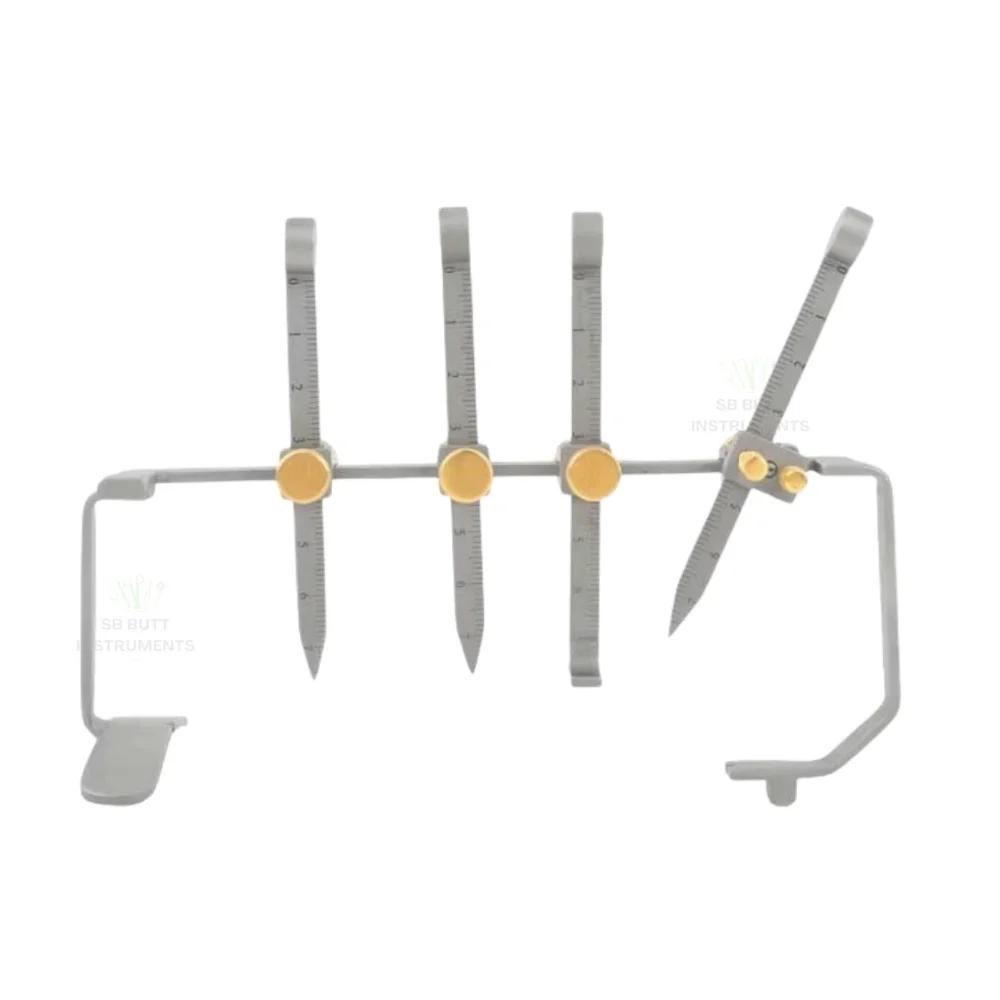
Davis Nasal Rhinoplasty Projectometer
Direct Manufacturer Pricing • Tax Exclusive
The Davis Nasal Rhinoplasty Projectometer is a specialized surgical measuring instrument designed to assess nasal projection, nasal dorsal height, and the nasolabial angle. Its adjustable measuring points and facial reference features support consistent measurements during rhinoplasty planning, intraoperative assessment, and postoperative evaluation.
All import duties, tariffs & taxes are 100% pre-paid for USA, UK, Canada, EUROPE & Australia (AUS). Zero surprise customs bills at delivery.
Hospital & Volume Procurement Pricing
The Davis Nasal Rhinoplasty Projectometer is a precision measuring instrument used in plastic surgery, rhinoplasty, and facial surgery to evaluate key nasal dimensions. Accurate assessment of nasal projection and angulation helps surgeons analyze facial proportions, plan surgical modifications, and document anatomical measurements. This specialized rhinoplasty instrument provides multiple measuring points within a single frame, supporting a structured approach to nasal assessment.
Applications in Rhinoplasty and Facial Plastic Surgery
The Davis Nasal Projectometer is designed to measure anatomical landmarks associated with nasal shape and projection. It can support preoperative planning, intraoperative measurement, and postoperative assessment during primary or revision rhinoplasty.
The instrument measures four key areas: the radix, rhinion, nasal tip, and nasolabial angle. The radix represents the upper nasal root, while the rhinion corresponds to the region where the nasal bones meet the upper lateral cartilages. Nasal tip projection describes how far the tip extends relative to a facial reference plane. The nasolabial angle helps assess the relationship between the columella and upper lip.
These measurements can assist surgeons in evaluating nasal proportions and documenting changes throughout the surgical process. The instrument may also be used in selected nasal reconstruction procedures, facial plastic surgery assessments, and clinical teaching.
Adjustable Measuring Points
A defining feature of the Davis Nasal Rhinoplasty Projectometer is its multiple independently adjustable measuring points. These allow the operator to position the measurement arms at specific anatomical landmarks without necessarily disturbing previously established settings.
Graduated scales support direct readings, while the adjustment mechanism helps secure the selected positions. Depending on the model, calibration markings may be provided along the horizontal and vertical axes to facilitate repeatable measurements.
The instrument's design allows several nasal measurements to be assessed using a common reference framework. This can be useful when comparing measurements obtained before surgery, during an operation, and at follow-up appointments.
Facial Reference and Positioning Design
The Davis Nasal Projectometer incorporates reference features intended to support consistent positioning against the facial anatomy. A notched forehead support helps establish midline alignment, while a dental stop provides an additional positioning reference. An angled or tilting measuring point facilitates assessment of the nasolabial angle.
These features help reduce reliance on visual estimation alone by providing a structured method for recording anatomical dimensions. Appropriate positioning remains essential, and measurements should be obtained by trained professionals following the instrument manufacturer's instructions.
Construction and Material
Davis nasal projectometers are commonly manufactured from surgical-grade stainless steel. This material is valued for its structural strength, corrosion resistance, and suitability for reusable surgical instruments when properly manufactured and maintained.
The exact stainless steel grade, surface finish, and component specifications may vary by manufacturer. Buyers should confirm these details with the supplier before purchasing.
A durable measuring frame and clearly legible graduated markings are important for maintaining instrument usability during repeated clinical assessments. The adjustment screws and measuring arms should be inspected regularly to ensure that they move and lock as intended.
Benefits for Surgical Professionals
The Davis Nasal Rhinoplasty Projectometer provides a dedicated solution for measuring nasal projection and selected facial angles. By bringing multiple measuring points into one instrument, it can help organize nasal assessment and reduce the need to switch between separate measuring tools.
Its adjustable design supports the evaluation of different anatomical landmarks, while the reference features help establish a consistent measurement position. These characteristics make the instrument useful for rhinoplasty specialists, facial plastic surgeons, and ENT professionals involved in appropriate nasal procedures.
The projectometer supports measurement and documentation; it does not independently determine surgical outcomes or replace clinical judgment.
Cleaning, Sterilization, and Maintenance
The Davis Nasal Projectometer must be supplied and processed according to the manufacturer's specifications. Reusable models identified as autoclavable should be cleaned, inspected, and sterilized using the validated procedures provided by the manufacturer.
Before reprocessing, removable components should be handled according to the instrument's instructions. Measuring arms, pins, adjustment screws, and contact surfaces should be checked for damage, corrosion, or restricted movement.
The instrument should be stored in a suitable protective environment to help prevent damage to its measuring components. Correct maintenance helps preserve the legibility of the scales and the function of the adjustment mechanism.
Healthcare facilities should confirm the instrument's reusable status, sterilization compatibility, and material specifications before clinical use.
Key Features
Specialized nasal measuring instrument for rhinoplasty and facial plastic surgery.
Designed to assess nasal projection and facial anatomical proportions.
Four measurement points: radix, rhinion, nasal tip, and nasolabial angle.
Independently adjustable measuring arms for landmark positioning.
Graduated calibration markings for recording measurements.
Notched forehead reference to support midline positioning.
Dental stop to assist with consistent instrument placement.
Angled measuring point for nasolabial angle assessment.
Commonly manufactured from surgical-grade stainless steel.
Suitable for preoperative planning and intraoperative measurement, depending on clinical requirements.
Reprocessing compatibility must be confirmed with the manufacturer.
Intended for use by trained surgical and medical professionals.
Product Specifications
| Specification | Details |
|---|---|
| Product Name | Davis Nasal Rhinoplasty Projectometer |
| Instrument Category | Surgical Measuring Instrument |
| Specialty | Rhinoplasty and Facial Plastic Surgery |
| Additional Applications | ENT and Nasal Reconstruction |
| Primary Function | Nasal Projection and Angulation Measurement |
| Measuring Points | Radix, Rhinion, Nasal Tip, Nasolabial Angle |
| Adjustment Mechanism | Independently Adjustable Measuring Points |
| Calibration | Graduated Measuring Scales |
| Positioning Features | Notched Forehead Reference and Dental Stop |
| Measuring Material | Stainless Steel, Grade to Be Confirmed |
| Surface Finish | Manufacturer-Specific |
| Reusable Status | Confirm with Supplier |
| Sterilization Compatibility | Confirm with Manufacturer |
| Packaging | Confirm with Supplier |
Frequently Asked Questions
1. What is a Davis Nasal Projectometer used for?
A Davis Nasal Projectometer is used to measure nasal projection, dorsal height at selected landmarks, and the nasolabial angle. It supports anatomical assessment and measurement documentation during rhinoplasty and related facial procedures.
2. Which anatomical points does the Davis Nasal Projectometer measure?
The instrument is designed to assess four areas: the radix, rhinion, nasal tip, and nasolabial angle. These measurements help surgeons evaluate nasal proportions and relationships with the surrounding facial anatomy.
3. Who uses a Davis Nasal Rhinoplasty Projectometer?
It is intended for qualified professionals involved in rhinoplasty, facial plastic surgery, and appropriate ENT procedures. It may also be used for clinical teaching and anatomical measurement.
4. What material is used to manufacture a Davis Nasal Projectometer?
Many versions are manufactured from surgical-grade stainless steel. The exact material grade and finish depend on the manufacturer and should be confirmed before purchase.
5. Is the Davis Nasal Projectometer autoclavable?
Some models are designed for repeated use and steam sterilization. Always verify the manufacturer's instructions and confirm sterilization compatibility for the specific model.
6. How does a nasal projectometer differ from a surgical caliper?
A conventional caliper measures the distance between selected points. A nasal projectometer incorporates facial reference features and multiple measuring points to support structured assessment of nasal projection and angulation.
7. Can the Davis Nasal Projectometer be used during rhinoplasty surgery?
It can support intraoperative nasal measurements when appropriate for the procedure and permitted by the manufacturer's instructions. Surgeons determine the appropriate measurement technique based on clinical requirements.
8. What should buyers check before purchasing a Davis Nasal Projectometer?
Buyers should verify the material grade, measuring scale, adjustment mechanism, included components, dimensions, reusable status, and sterilization instructions to ensure that the instrument meets their clinical requirements.