
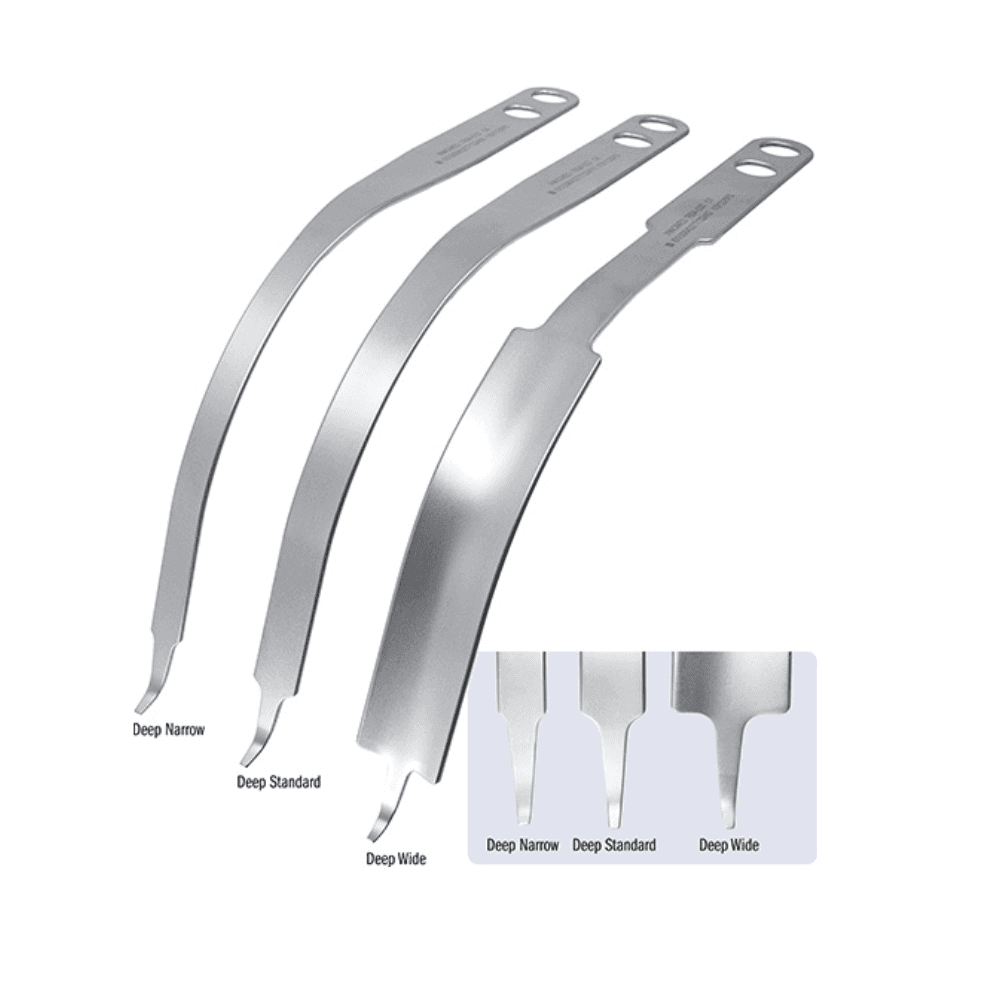
Deep Curved Anterior Retractors
Direct Manufacturer Pricing • Tax Exclusive
All import duties, tariffs & taxes are 100% pre-paid for USA, UK, Canada, EUROPE & Australia (AUS). Zero surprise customs bills at delivery.
Hospital & Volume Procurement Pricing
Deep Curved Anterior Retractors are specialized surgical instruments designed to provide controlled soft-tissue retraction during procedures requiring deeper anterior exposure. Their curved configuration allows the retractor to follow the contours of the operative area while providing a defined surface for maintaining tissue displacement.
These retractors may be used in selected orthopedic and spinal procedures where access to an anterior surgical field requires stable and controlled retraction. The deep profile is intended to provide additional reach, while the curved blade can help accommodate the anatomy around the operative site. Actual use depends on the surgical approach, anatomical requirements, and specific dimensions of the retractor.
The curved design can provide a practical advantage when a straight retractor does not provide the desired positioning around the surgical field. By following the contour of the target area, the blade can support controlled tissue displacement while allowing the surgical team to maintain access to the operative site. Appropriate placement and controlled force are essential when using any surgical retractor.
Deep Curved Anterior Retractors are intended for professional operating-room environments, including hospitals, orthopedic surgical centers, and specialty surgical facilities. Their rigid construction is designed to provide stable handling and positioning during procedures where dependable tissue exposure is required.
These retractors are commonly manufactured from surgical-grade stainless steel or another suitable medical instrument material, depending on the supplied product specification. Durable construction is intended to support repeated surgical handling and, where the instrument is designated as reusable, repeated cleaning and sterilization according to validated reprocessing procedures.
After use, reusable retractors should be cleaned according to the manufacturer's validated instructions. The instrument should be inspected for visible damage, deformation, residue, or other conditions that could affect performance. It should then be thoroughly dried and sterilized using a validated method compatible with the specific instrument. Healthcare facilities should follow their established infection-control and reprocessing protocols.
When selecting a Deep Curved Anterior Retractor, users should consider the overall length, blade depth, blade width, curvature, and intended surgical application. Different configurations may be designed for different anatomical approaches, so exact product dimensions and specifications should be verified before ordering.
Deep Curved Anterior Retractors provide a focused solution for surgical teams requiring controlled exposure in deeper anterior operative fields. Their deep, curved configuration supports positioning around selected anatomical structures while maintaining a stable retraction point during appropriate surgical procedures.
Key Features
- Deep curved anterior surgical retractor design
- Designed for controlled soft-tissue retraction
- Curved profile for positioning around anatomical structures
- Deep configuration for increased operative reach
- Suitable for selected orthopedic procedures
- Suitable for selected anterior spine procedures
- Supports controlled surgical exposure
- Rigid construction for stable positioning
- Designed for professional operating-room environments
- Reusable when designated by the manufacturer
- Requires appropriate cleaning and sterilization procedures
- Available in configurations based on surgical requirements
Product Specifications
| Specification | Details |
|---|---|
| Product Name | Deep Curved Anterior Retractors |
| Instrument Type | Surgical Retractor |
| Design | Deep Curved Anterior |
| Retraction Type | Soft-Tissue Retraction |
| Primary Applications | Orthopedic and Spine Surgery |
| Surgical Approach | Anterior |
| Blade Profile | Deep and Curved |
| Construction | Surgical-Grade Instrument Material |
| Reusable | Depending on supplied configuration |
| Sterilization | Follow manufacturer-validated reprocessing instructions |
| Dimensions | Verify selected configuration |
| Compatibility | Select according to surgical application and dimensions |
FAQs
What are Deep Curved Anterior Retractors?
Deep Curved Anterior Retractors are surgical instruments designed to provide controlled tissue retraction and exposure in deeper anterior operative fields.
What are Deep Curved Anterior Retractors used for?
They are used for controlled soft-tissue retraction during selected orthopedic, spinal, and other procedures requiring deeper anterior surgical exposure.
What is the benefit of the curved design?
The curved blade can help the instrument follow the contour of selected anatomical structures, supporting controlled positioning around the operative field.
Can these retractors be used for anterior spine surgery?
They may be used in selected anterior spinal procedures where controlled tissue retraction is required. The appropriate configuration should be selected according to the surgical approach.
Why is the retractor designed to be deep?
The deeper profile provides additional working reach for operative areas where a shorter retractor may not provide sufficient exposure.
Are Deep Curved Anterior Retractors reusable?
If the supplied instruments are designated as reusable, they should be cleaned, inspected, dried, and sterilized according to the manufacturer's validated instructions.
What material are these retractors made from?
They are commonly manufactured from surgical-grade stainless steel or another suitable medical instrument material. Exact material should be verified from the supplied specification.
How should Deep Curved Anterior Retractors be sterilized?
Reusable versions should be processed according to the manufacturer's validated cleaning and sterilization instructions and the healthcare facility's approved reprocessing protocol.