
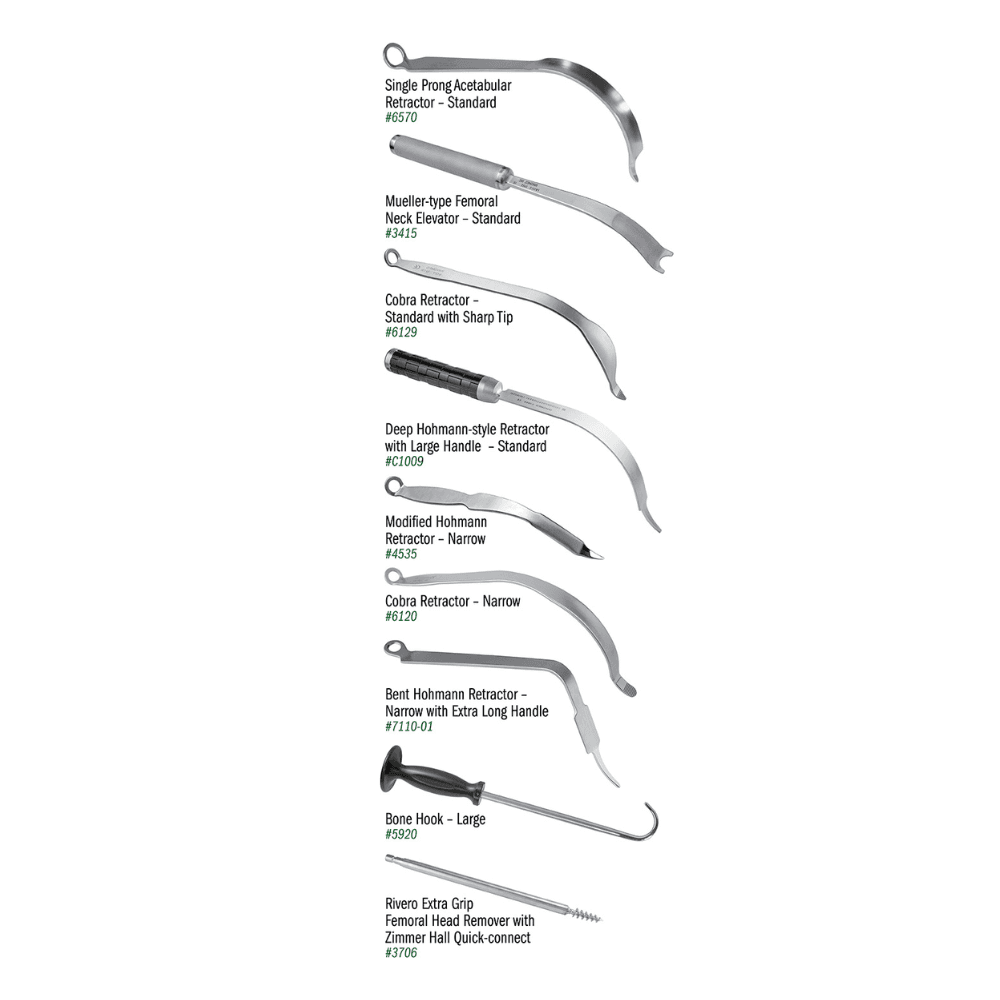
Direct Anterior Approach Instrument Set
Direct Manufacturer Pricing • Tax Exclusive
All import duties, tariffs & taxes are 100% pre-paid for USA, UK, Canada, EUROPE & Australia (AUS). Zero surprise customs bills at delivery.
Hospital & Volume Procurement Pricing
The Direct Anterior Approach Instrument Set is designed for orthopedic surgeons performing direct anterior total hip arthroplasty and related hip replacement procedures. The anterior approach requires specialized instruments that can provide controlled access to the hip joint while supporting soft tissue management and femoral exposure through the anterior surgical corridor.
This instrument set brings together commonly required orthopedic tools for different stages of the direct anterior hip procedure. Depending on the configuration, instruments may assist with surgical exposure, soft tissue retraction, femoral neck access, proximal femoral elevation, acetabular exposure, and preparation of the femoral canal for implant placement.
Direct anterior hip surgery places specific requirements on instrument geometry and working length. Retractors and elevators with appropriately shaped blades can help maintain exposure while accommodating the anatomy and limited working space associated with the anterior approach. A dedicated instrument set allows the surgical team to organize compatible tools for the procedure and select the appropriate instrument during each operative stage.
The set can be used alongside compatible acetabular reamers, femoral preparation instruments, trial components, implant impactors, femoral stem instruments, and other total hip arthroplasty equipment. Instrument selection should be based on the surgical technique, implant system, patient anatomy, and requirements of the operating team.
The instruments are intended for professional orthopedic surgical environments. Reusable instruments are generally designed for repeated clinical use when properly maintained and processed according to validated manufacturer instructions. Surgical-grade stainless steel is commonly used for orthopedic instruments because of its strength, corrosion resistance, and compatibility with established cleaning and sterilization procedures. Exact material specifications may vary according to the individual instrument.
Before use, every instrument should be inspected for damage, corrosion, deformation, proper alignment, and functional integrity. Retractors and elevators should be checked for secure construction and appropriate blade condition, while instruments with moving components should be inspected for smooth operation.
Following use, reusable instruments should undergo appropriate cleaning, decontamination, inspection, packaging, and sterilization according to the manufacturer's validated instructions and the healthcare facility's infection-control protocols. Proper maintenance helps preserve instrument performance and service life.
The Direct Anterior Approach Instrument Set provides a practical solution for orthopedic teams requiring dedicated instrumentation for anterior hip replacement. By combining specialized exposure and preparation instruments into one organized set, it supports an efficient surgical workflow from initial exposure through femoral and acetabular preparation.
Key Features
- Designed for direct anterior hip surgery
- Suitable for total hip arthroplasty procedures
- Supports controlled surgical exposure
- Provides specialized soft tissue retraction
- Supports femoral neck and proximal femoral access
- Helps facilitate acetabular exposure
- Suitable for femoral preparation procedures
- Designed for professional orthopedic operating rooms
- Complements compatible THA implant systems
- Supports organized surgical workflow
- Reusable instruments can be processed according to validated instructions
- Available as a dedicated anterior approach instrument set
Product Specifications
| Specification | Details |
|---|---|
| Product Name | Direct Anterior Approach Instrument Set |
| Instrument Type | Orthopedic Surgical Instrument Set |
| Surgical Specialty | Orthopedic Surgery |
| Primary Application | Direct Anterior Hip Surgery |
| Common Procedure | Total Hip Arthroplasty |
| Surgical Approach | Direct Anterior Approach |
| Primary Functions | Exposure, Retraction, Femoral and Acetabular Access |
| Operative Area | Hip / Pelvic Region |
| Instrument Material | Surgical-grade material, configuration dependent |
| Reusable | Yes, where applicable |
| Sterilization | Follow validated manufacturer instructions |
FAQs
What is a Direct Anterior Approach Instrument Set?
It is a specialized orthopedic surgical set containing instruments designed to support exposure, retraction, femoral access, and preparation during direct anterior hip procedures.
What is this instrument set used for?
The set is used to support different stages of direct anterior total hip arthroplasty, including surgical exposure, soft tissue retraction, femoral access, and preparation.
Is this set suitable for total hip replacement?
Yes. It is designed for use in direct anterior total hip arthroplasty and related orthopedic hip replacement procedures.
What instruments are commonly included in an anterior approach set?
Depending on the configuration, an anterior hip set may include retractors, femoral elevators, hooks, femoral preparation instruments, acetabular exposure instruments, and other specialized orthopedic tools.
Can the set be used with different hip implant systems?
Compatibility depends on the individual instruments, implant system, and surgical technique. The surgical team should verify compatibility before use.
Are the instruments reusable?
Reusable status depends on the individual instruments supplied in the set. Reusable instruments should be cleaned, inspected, and sterilized according to validated manufacturer instructions.
How should the instrument set be sterilized?
Cleaning, disinfection, packaging, and sterilization should be performed according to the manufacturer's validated processing instructions and applicable healthcare-facility protocols.
What should be inspected before using the set?
Each instrument should be checked for damage, corrosion, deformation, proper alignment, functional movement, and overall structural integrity before use.