
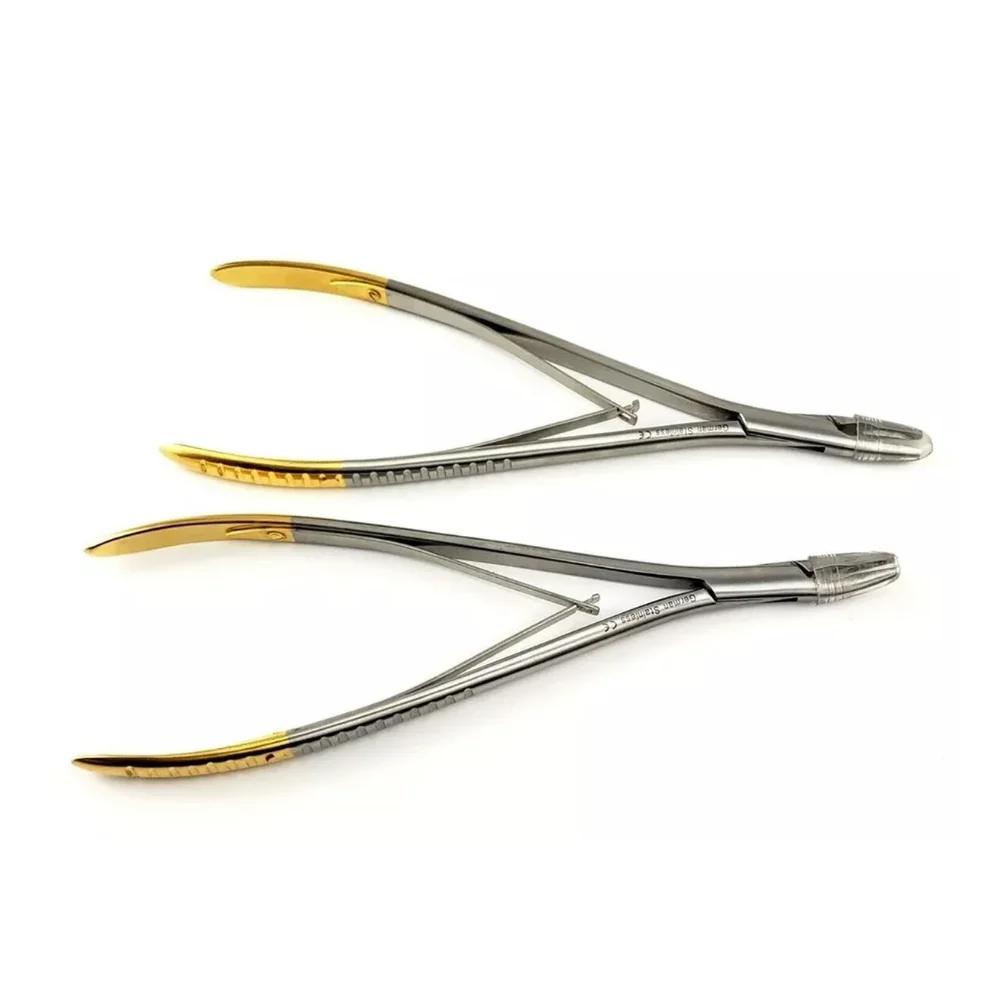
Lempert Bone Rongeur 8″ Straight & Curved Gold Handles
Direct Manufacturer Pricing • Tax Exclusive
The Lempert Bone Rongeur is an orthopedic and ENT surgical instrument designed for controlled removal of small bone fragments and trimming of bone tissue. Available in 8-inch straight and curved configurations, it features German stainless steel construction and distinctive gold-finished handles for professional surgical use.
All import duties, tariffs & taxes are 100% pre-paid for USA, UK, Canada, EUROPE & Australia (AUS). Zero surprise customs bills at delivery.
Hospital & Volume Procurement Pricing
The Lempert Bone Rongeur is a specialized surgical instrument designed for removing small bone fragments, trimming bone edges, and performing controlled bone removal during appropriate surgical procedures. Its compact jaw mechanism allows the surgeon to engage targeted bone tissue and remove small portions progressively, supporting precision in anatomically restricted areas.
With an overall length of 8 inches, this instrument is suitable for surgical settings where controlled access and careful manipulation are required. Lempert-style rongeurs are commonly associated with ENT and other procedures involving bone removal, although the exact applications depend on the jaw configuration, instrument specifications, and the surgeon's technique.
Straight and Curved Jaw Configurations
The Lempert Bone Rongeur is available in straight and curved versions to accommodate different surgical approaches. A straight configuration provides a direct working path toward the target area, while a curved configuration can help the operator approach bone from an adjusted angle.
The choice between these designs depends on the anatomical location, visibility, available working space, and procedural requirements. Both configurations are intended to support controlled engagement of bone tissue. The precise jaw dimensions, cutting profile, and mechanism should be confirmed with the supplier before ordering.
German Stainless Steel Construction
This Lempert bone rongeur is specified as being manufactured from German stainless steel. Stainless steel is widely used in reusable surgical instruments because of its mechanical strength, corrosion resistance, and suitability for repeated cleaning and sterilization when maintained correctly.
The quality of the cutting edges and alignment of the jaws are important for consistent performance. Before use, inspect the instrument for jaw misalignment, wear, corrosion, or damage that could interfere with its operation. The specific steel grade and manufacturing standards should be verified through the supplier's documentation.
Gold-Finished Handles
The gold-finished handles provide a distinctive appearance and can serve as a visual identifier for certain instrument designs. Gold-colored surgical instrument handles are sometimes associated with tungsten carbide inserts or other specialized construction, but the finish alone does not confirm the presence of tungsten carbide.
Buyers should verify whether the handles are simply gold-finished or incorporate tungsten carbide components. This distinction is important when assessing the instrument's construction, maintenance requirements, and intended performance.
Ergonomics and Surgical Control
The 8-inch length provides a practical working reach for appropriate bone-removal procedures. The handle mechanism is designed to transmit manual pressure to the working jaws, allowing the operator to remove bone incrementally rather than attempting extensive removal in a single action.
Controlled use helps the surgeon manage the amount and location of bone removed. The instrument must be used by trained professionals who understand the relevant anatomy and the limitations of the specific rongeur design.
Cleaning, Sterilization, and Maintenance
If supplied as a reusable instrument, the Lempert Bone Rongeur must be cleaned, inspected, dried, and sterilized according to the manufacturer's validated instructions. The jaw area and moving mechanism require particular attention because tissue residue can accumulate around the cutting surfaces and joints.
The instrument should be checked for smooth movement, proper jaw closure, and intact cutting edges before each use. Appropriate storage and maintenance help preserve its function and service life. Reprocessing procedures must follow the manufacturer's instructions and applicable healthcare facility protocols.
The Lempert Bone Rongeur – 8″ Straight & Curved, German Stainless Steel with Gold Handles is a specialized addition to orthopedic and ENT instrument inventories. Confirm the exact configuration, jaw specifications, steel grade, handle construction, and reprocessing requirements before procurement.
Key Features
Lempert-style bone rongeur for controlled bone removal
Available in straight and curved configurations
8-inch overall length for surgical access and handling
German stainless steel construction, as specified
Gold-finished handles for a distinctive instrument appearance
Designed for removing small bone fragments and trimming bone edges
Suitable for selected ENT and other bone-removal procedures
Jaw alignment and cutting-edge condition should be checked before use
Tungsten carbide handle inserts are not confirmed by the gold finish alone
Follow manufacturer instructions for cleaning, sterilization, and maintenance
Product Specifications
Specification | Details |
|---|---|
Product Name | Lempert Bone Rongeur |
Instrument Category | Bone Rongeur |
Overall Length | 8 inches |
Metric Length | Approximately 20.3 cm |
Jaw Configuration | Straight or curved |
Material | German stainless steel, as specified |
Handle Finish | Gold finish |
Handle Insert Material | Not specified; verify with supplier |
Primary Function | Bone trimming and removal of small bone fragments |
Potential Specialties | ENT and selected orthopedic or surgical procedures |
Operating Mechanism | Manual jaw mechanism |
Sterilization | Follow manufacturer instructions |
Reusability | Confirm product labeling |
Manufacturer | Not specified |
Model Number | Not specified |
Frequently Asked Questions
1. What is a Lempert Bone Rongeur used for?
A Lempert Bone Rongeur is used to remove small bone fragments, trim bone edges, and perform controlled bone removal during appropriate surgical procedures.
2. What is the difference between straight and curved Lempert rongeurs?
A straight rongeur provides a direct approach to the target bone, while a curved rongeur offers an angled approach that may be useful in areas with limited access.
3. How long is an 8-inch Lempert Bone Rongeur?
The instrument measures 8 inches, approximately 20.3 cm, in overall length.
4. What are the benefits of German stainless steel in surgical instruments?
Surgical-grade stainless steel offers mechanical strength and corrosion resistance when properly maintained. The exact performance depends on the steel grade, manufacturing quality, and reprocessing practices.
5. Do gold handles mean the Lempert rongeur has tungsten carbide inserts?
Not necessarily. Gold coloring can be a finish or an indicator used on certain instrument designs, but it does not independently establish the handle insert material. Confirm this detail with the manufacturer or supplier.
6. Is the Lempert Bone Rongeur used in ENT surgery?
Lempert-style rongeurs are associated with ENT procedures involving bone removal. Suitability depends on the exact jaw design, intended application, and manufacturer's specifications.
7. How should a Lempert Bone Rongeur be sterilized?
If designated reusable, the instrument should be cleaned, inspected, and sterilized according to the manufacturer's validated instructions. Pay particular attention to the jaws and moving mechanism.
8. What should buyers check before ordering a Lempert Bone Rongeur?
Verify the length, straight or curved configuration, jaw dimensions, material grade, handle construction, manufacturer, and reprocessing instructions before placing an order.