
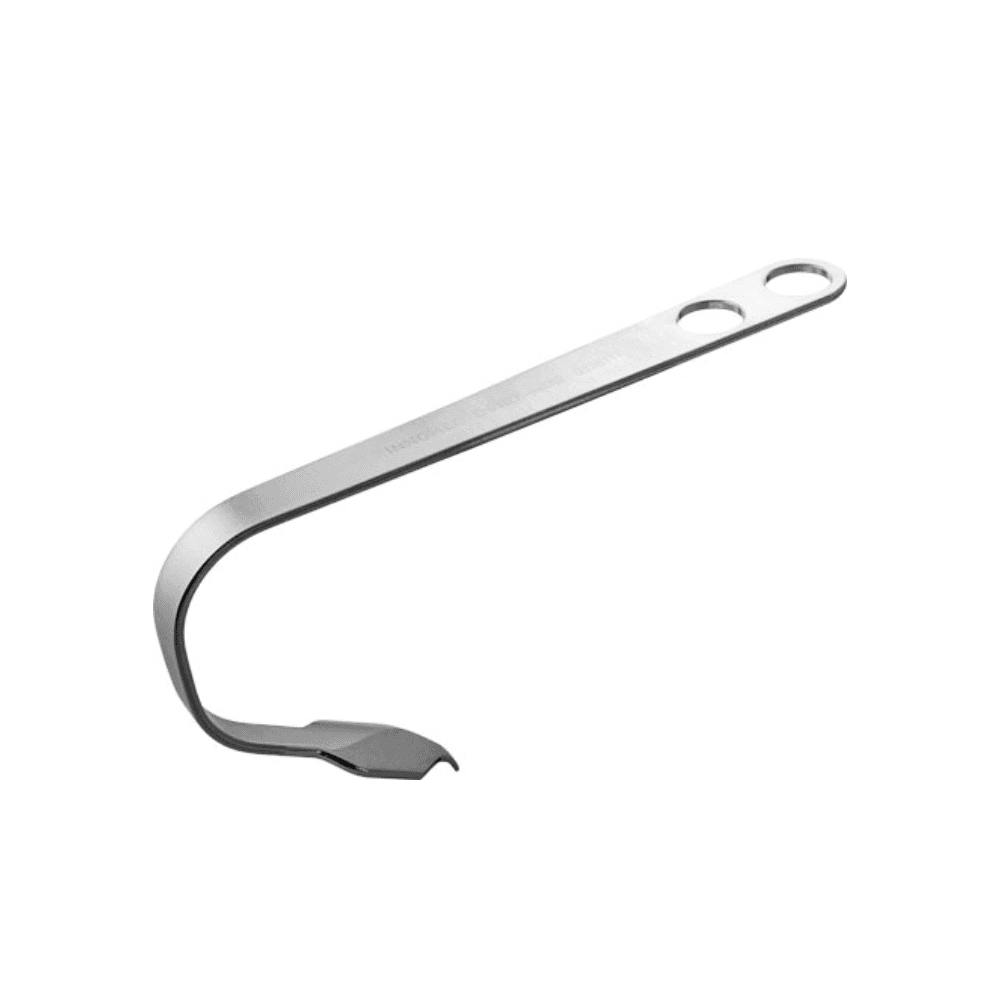
Modified Curved Double Bent Hohmann Retractor
Direct Manufacturer Pricing • Tax Exclusive
All import duties, tariffs & taxes are 100% pre-paid for USA, UK, Canada, EUROPE & Australia (AUS). Zero surprise customs bills at delivery.
Hospital & Volume Procurement Pricing
The Modified Curved Double Bent Hohmann Retractor is a specialized orthopedic surgical instrument designed to provide controlled retraction during procedures involving bone, soft tissue, and deeper anatomical structures. Its curved, double-bent configuration is intended to help the surgeon achieve targeted exposure while maintaining the handle at a practical working angle outside the immediate operative area.
Hohmann-style retractors are commonly used in orthopedic surgery where controlled retraction is required to improve visualization and access to the surgical site. The modified curved profile of this instrument can be useful when a conventional straight retractor does not provide the desired approach or working angle. The double-bent design allows the working end to follow the intended anatomical contour while the handle remains positioned for manual control.
The Modified Curved Double Bent Hohmann Retractor may be incorporated into orthopedic instrument sets used for hip surgery, joint procedures, fracture fixation, and other operations where exposure around bone and surrounding soft tissue is required. Its exact application depends on the retractor's dimensions, blade configuration, surgical approach, and the surgeon's preferred technique.
The working end is designed to engage the selected anatomical area and provide controlled retraction. Proper positioning is important to maintain stable exposure while avoiding unnecessary pressure on surrounding tissues. The instrument should be placed carefully and manipulated using controlled force appropriate for the surgical application.
The curved and double-bent geometry can provide useful versatility when working around anatomical structures that are difficult to access with a straight instrument. This type of configuration may be particularly useful in orthopedic procedures where the surgical team needs a retractor that can approach the operative site from a specific direction while keeping the handle clear of other instruments.
The instrument's manual design allows the surgeon or surgical assistant to control placement and retraction directly. It can be used alongside other Hohmann retractors, acetabular retractors, femoral retractors, and orthopedic exposure instruments when different retraction angles or working depths are required.
The Modified Curved Double Bent Hohmann Retractor should be used only for its intended surgical purpose and with an appropriate surgical technique. Excessive force should be avoided, as inappropriate loading or positioning can potentially cause tissue injury, instrument deformation, or loss of controlled exposure.
For instruments designated as reusable, proper reprocessing is an essential part of maintaining their condition. Following use, the retractor should be cleaned according to the manufacturer's validated instructions to remove blood, tissue, and other contaminants. The curved working surfaces and any areas around bends should receive appropriate attention during cleaning.
Before subsequent use, the instrument should be inspected for bending, deformation, cracks, surface damage, excessive wear, or other defects. The working end should remain properly aligned and free from damage that could affect its intended function.
Sterilization, packaging, storage, and maintenance should follow the manufacturer's validated instructions and the healthcare facility's established sterile-processing procedures. Proper handling and reprocessing help preserve the instrument's functional condition and support safe use in subsequent procedures.
The Modified Curved Double Bent Hohmann Retractor is a practical addition to orthopedic surgical instrument systems requiring controlled exposure around bone and soft tissue. Its modified curved profile and double-bent configuration provide an alternative working geometry for orthopedic procedures where targeted retraction and access are required.
Key Features
- Modified curved double-bent Hohmann design
- Designed for controlled orthopedic tissue retraction
- Curved profile supports targeted surgical exposure
- Double-bent configuration provides an angled working approach
- Useful for bone and soft tissue retraction
- Suitable for orthopedic surgical procedures
- Can be used alongside other Hohmann retractors
- Manual operation for direct positioning and control
- Useful for hip and other orthopedic procedures
- Designed for professional surgical environments
- Reusable when specifically designated for reusable use
- Requires appropriate cleaning, inspection, and sterilization
Product Specifications
| Specification | Details |
|---|---|
| Product Name | Modified Curved Double Bent Hohmann Retractor |
| Instrument Type | Orthopedic Retractor |
| Design | Modified Curved Double Bent |
| Primary Function | Tissue and Bone Retraction |
| Surgical Specialty | Orthopedic Surgery |
| Application | Surgical Exposure and Retraction |
| Operation | Manual |
| Working Configuration | Curved / Double Bent |
| Construction | Surgical Instrument Construction |
| Reusable | Yes, when designated for reusable use |
| Sterilization | According to manufacturer-validated instructions |
| Compatibility | Verify according to surgical technique and instrument system |
FAQs
What is a Modified Curved Double Bent Hohmann Retractor used for?
It is used for controlled retraction of soft tissue and bone to assist surgical exposure during orthopedic procedures.
What is the benefit of the double-bent design?
The double-bent configuration provides an angled working geometry that can help the instrument approach the operative site while keeping the handle positioned away from the immediate surgical area.
Is this Hohmann retractor used in hip surgery?
It may be used in hip and other orthopedic procedures where its curved configuration and dimensions are appropriate for the required exposure.
What is a curved Hohmann retractor?
A curved Hohmann retractor is an orthopedic retractor with a curved working profile designed to facilitate controlled retraction around anatomical structures.
Can it be used for bone retraction?
Hohmann-style retractors may be used for controlled bone and soft tissue retraction depending on the instrument's design and the surgical technique.
Is the Modified Curved Double Bent Hohmann Retractor reusable?
It may be reusable when specifically manufactured and designated for reusable surgical use. Cleaning, inspection, maintenance, and sterilization should follow validated instructions.
How should this retractor be sterilized?
Sterilization should be performed according to the manufacturer's validated reprocessing instructions and the healthcare facility's sterile-processing protocol.
What should be checked before using the retractor?
The working end, bends, overall alignment, handle, and surfaces should be inspected for cracks, deformation, excessive wear, or other damage before use.