

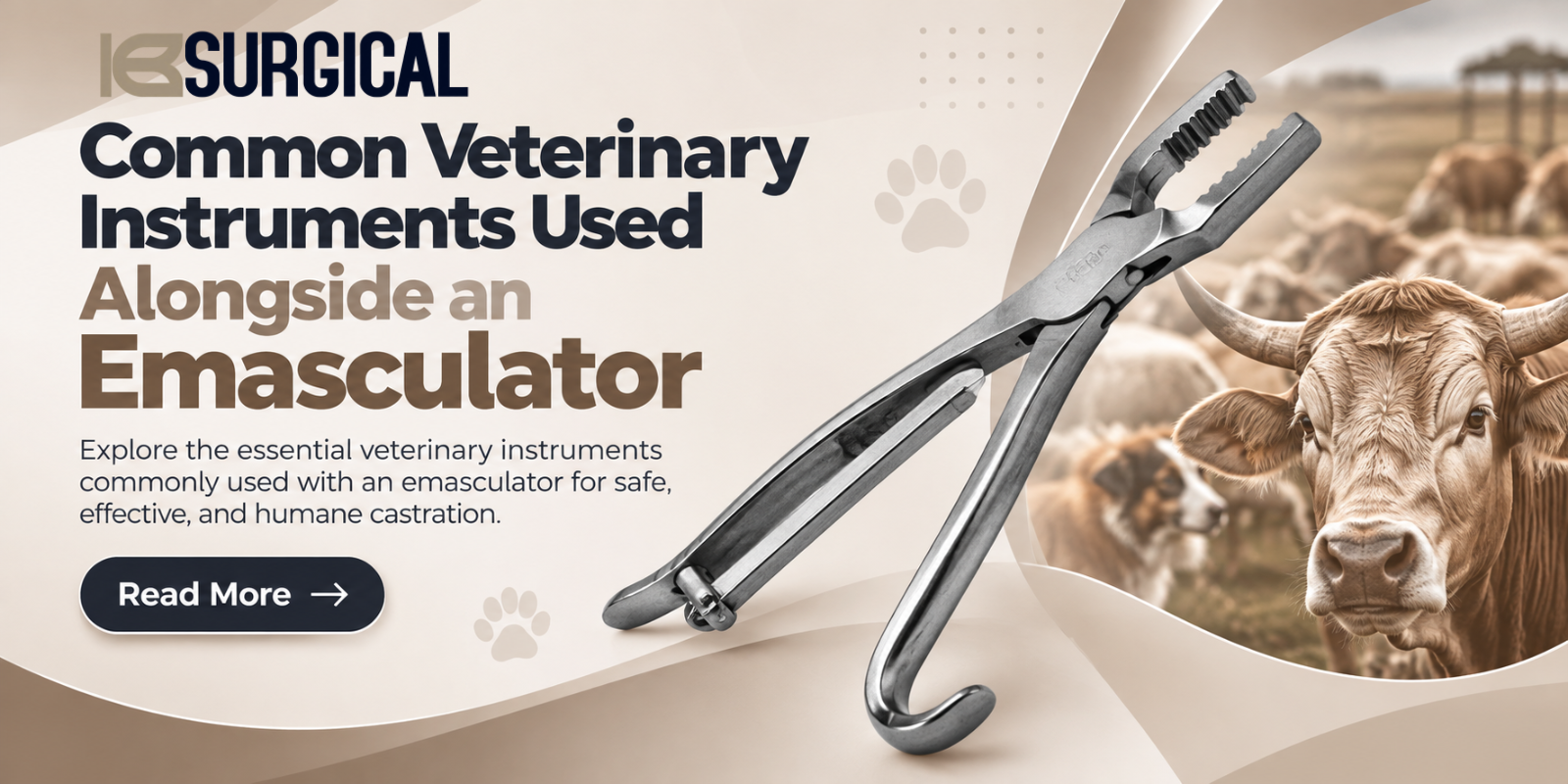
Veterinary surgery often requires a combination of specialized instruments to support safe, controlled, and efficient procedures. In large-animal veterinary practice, an emasculator is a specialized instrument used during castration procedures to crush tissue and transect the spermatic cord, depending on the instrument design. However, it is rarely the only instrument needed for the procedure.
Other veterinary surgical instruments help practitioners examine the animal, handle tissues, control bleeding, maintain access to the surgical site, and complete wound care. Understanding the purpose of these instruments helps veterinary professionals select suitable equipment for their clinical needs.
In this guide, we explore the common veterinary instruments used alongside an emasculator, their functions, and the factors to consider when selecting them.
What Is an Emasculator?
An emasculator is a veterinary surgical instrument primarily used for castration in male livestock and other large animals. Its jaws are designed to crush and sever the spermatic cord, helping control bleeding during the procedure.
The Kern Emasculator is one example of an instrument pattern used in veterinary practice. The exact jaw configuration, dimensions, and handling characteristics depend on the specific model.
An emasculator should be selected according to the animal species, anatomical requirements, and intended procedure. Proper instrument selection, handling, and maintenance are important considerations for veterinary professionals.
1. Veterinary Surgical Scissors
Surgical scissors are commonly used in veterinary procedures for cutting soft tissue, sutures, and other appropriate materials. The specific type selected depends on the task and the tissue involved.
Common varieties include:
Mayo scissors: Designed for cutting heavier tissues or suitable surgical materials, depending on the pattern.
Metzenbaum scissors: Generally used for delicate soft-tissue dissection.
Straight surgical scissors: Often suitable for cutting sutures, dressings, or materials when the design permits.
Curved surgical scissors: Provide a different approach to cutting and dissecting tissue.
In procedures involving an emasculator, scissors may be required for associated surgical tasks. They should not be considered interchangeable, and the appropriate design should be chosen for the intended use.
2. Veterinary Dissecting Forceps
Dissecting forceps help practitioners grasp, hold, and manipulate tissues during surgical procedures. They are available in several designs, including toothed and non-toothed patterns.
Common types include:
Adson forceps: Commonly used for handling tissue in procedures where their size and jaw design are appropriate.
Dressing forceps: Used for handling dressings and other suitable materials.
Tissue forceps: Designed to provide a grip on tissue, with the degree of grip depending on the jaw configuration.
The selection of forceps depends on the tissue involved and the degree of control required. Veterinary professionals should use a pattern appropriate to the animal and procedure while minimizing unnecessary tissue trauma.
3. Hemostatic Forceps and Artery Clamps
Hemostatic forceps are designed to clamp blood vessels or other suitable tissues to assist with bleeding control. They are available in different lengths, jaw patterns, and locking mechanisms.
Common examples include:
Halsted mosquito forceps: Small hemostatic instruments used for delicate work.
Kelly hemostatic forceps: Available in straight and curved patterns for different clinical applications.
Crile hemostatic forceps: Designed for clamping appropriate vessels and tissues.
Rochester-Pean forceps: A heavier pattern used when a larger instrument is required.
These instruments may form part of a veterinary surgical tray when additional bleeding-control instruments are needed. They have a different function from an emasculator, and the two instruments should not be treated as substitutes for each other.
4. Scalpel Handles and Surgical Blades
Scalpel handles and compatible surgical blades are used to make controlled incisions when indicated by the procedure. Different blade shapes are designed for different cutting requirements.
Common options include:
Scalpel handle No. 3: Compatible with a range of smaller surgical blades.
Scalpel handle No. 4: Commonly used with larger compatible blades.
Surgical blades No. 10, 11, and 15: Differ in shape and intended cutting applications.
The correct handle and blade combination depends on the surgical task and the manufacturer's compatibility guidance. Blades must be handled and disposed of using appropriate sharps-safety procedures.
5. Needle Holders
Needle holders are used to grasp and control surgical needles during suturing. They help practitioners maintain control while placing sutures where wound closure is required.
Frequently used patterns include:
Mayo-Hegar needle holder: A general-purpose pattern available in several sizes.
Crile-Wood needle holder: Commonly used for more delicate suturing tasks.
Olsen-Hegar needle holder: Combines a needle-holding mechanism with scissors in a single instrument.
The best choice depends on the needle size, suture material, required precision, and animal species. Not every veterinary procedure requires suturing, so the need for a needle holder depends on the surgical approach and wound-management plan.
6. Retractors
Retractors help hold tissues aside to improve access and visibility at a surgical site. They are available in handheld and self-retaining designs.
Examples include:
Senn retractors: Small retractors used for superficial tissue retraction.
Army-Navy retractors: Handheld instruments used to retract tissue where their size is suitable.
Weitlaner retractors: Self-retaining instruments used in selected procedures.
Gelpi retractors: Self-retaining retractors with pointed tips, used when their design is appropriate.
The need for a retractor depends on the procedure, anatomical location, and surgical approach. Retractors should be selected to provide adequate access without applying unnecessary pressure to surrounding tissues.
7. Towel Clamps and Draping Instruments
Towel clamps help secure surgical drapes or towels around the operative field. Maintaining a properly prepared surgical field supports aseptic technique.
Common patterns include Backhaus towel clamps and other suitable draping clamps. Their design, sharpness, and intended application should be considered before use.
These instruments are supporting items rather than essential components of every castration tray. Their inclusion depends on the clinical setting and the procedure's sterile-field requirements.
8. Probe and Director Instruments
Veterinary probes and directors are used in selected examinations and surgical procedures to explore or guide instruments along appropriate anatomical paths.
Their uses depend on the specific design and clinical indication. They should not be included automatically in every emasculator set, as the requirements for a procedure vary by species, technique, and practitioner preference.
9. Needle and Suture Supplies
When wound closure is indicated, suitable suture materials and needles are important components of the surgical supplies. Different suture materials vary in absorption characteristics, strength, handling properties, and intended tissue applications.
Veterinary professionals select sutures according to the procedure, tissue type, contamination considerations, and expected healing requirements. Some castration techniques are managed without routine external suturing, so these supplies may not be required in every case.
10. Instrument Trays and Sterilization Accessories
A suitable instrument tray helps organize instruments, maintain an orderly setup, and support their processing before and after use.
Supporting supplies may include:
Stainless steel instrument trays
Instrument baskets and holders
Cleaning brushes suitable for reusable instruments
Approved instrument detergents
Sterilization wraps or containers compatible with the processing method
Reusable surgical instruments should be cleaned, inspected, packaged when required, and sterilized according to the manufacturer's instructions and applicable veterinary infection-prevention protocols. Visible cleanliness alone does not establish that an instrument is sterile.
How to Select Instruments for a Veterinary Emasculator Set
Selecting instruments for a veterinary procedure involves more than choosing an emasculator. The complete selection should reflect the animal species, procedure, surgical technique, clinical environment, and practitioner's requirements.
Consider these factors when assembling a veterinary surgical set:
1. Animal species and size: Instrument dimensions should be suitable for the animal and the intended anatomical application.
2. Instrument quality: Look for appropriate materials, sound construction, functional joints, and jaws that align correctly.
3. Intended function: Each instrument should have a defined purpose. Avoid adding unnecessary tools or substituting instruments designed for different tasks.
4. Compatibility: Confirm that the instruments are appropriate for the procedure and compatible with the facility's cleaning and sterilization processes.
5. Maintenance requirements: Reusable instruments need routine inspection for corrosion, damage, stiffness, misalignment, and impaired locking mechanisms.
6. Veterinary expertise: Instrument selection and procedural decisions should be made by a qualified veterinary professional based on the animal and clinical circumstances.
Cleaning, Sterilization, and Maintenance
Proper instrument care supports instrument longevity and infection prevention. After use, reusable instruments should be handled safely and processed promptly according to their manufacturer's instructions.
A typical instrument-care program includes removal of organic material, appropriate cleaning, rinsing and drying, inspection, lubrication when specified, packaging where required, and validated sterilization.
Pay particular attention to the jaws, joints, ratchets, and moving parts of an emasculator. Residual debris, corrosion, damaged cutting or crushing surfaces, and faulty alignment can affect instrument function. Instruments that fail inspection should be removed from service until appropriately evaluated or repaired.
The sterilization method and processing parameters must be compatible with the instrument's materials and manufacturer guidance.
Frequently Asked Questions
What instruments are commonly used alongside an emasculator?
Depending on the procedure, supporting instruments may include surgical scissors, dissecting forceps, hemostatic forceps, a scalpel handle and blade, needle holders, retractors, and instrument trays. Not every procedure requires all these items.
What is the main purpose of a Kern Emasculator?
A Kern Emasculator is a veterinary instrument pattern used for castration procedures. Emasculators are designed to crush and sever the spermatic cord, with the precise mechanism and use depending on the model.
Are all veterinary emasculators the same?
No. Emasculators differ in size, jaw design, mechanism, and intended application. The appropriate pattern should be selected for the animal, procedure, and manufacturer's specifications.
Do veterinary emasculator sets always include scissors and forceps?
No. Set contents vary by supplier and intended application. Some instruments are sold individually, allowing veterinary professionals to assemble a tray based on their clinical requirements.
How should an emasculator be maintained?
It should be cleaned, inspected, and sterilized according to the manufacturer's instructions and applicable veterinary protocols. Its jaws, alignment, joints, and moving components should be checked for damage or impaired function.
What material is commonly used to manufacture veterinary surgical instruments?
Stainless steel is widely used because of its strength, corrosion resistance, and suitability for many reusable surgical instruments. The specific grade and processing requirements vary by product.
Conclusion
An emasculator is an important specialized instrument in large-animal veterinary practice, but a surgical procedure may also require supporting instruments for tissue handling, cutting, bleeding control, access, and wound management. Scissors, forceps, hemostatic clamps, scalpel components, needle holders, and retractors each serve distinct purposes.
Choosing instruments according to the procedure, animal species, and manufacturer's guidance helps veterinary professionals prepare an appropriate surgical setup. Regular inspection, correct cleaning, and validated sterilization are equally important for maintaining reusable veterinary instruments.
For veterinary practices and instrument buyers, understanding the role of each instrument makes it easier to evaluate individual products and assemble a suitable veterinary surgical instrument collection.