

Bone drilling instruments are essential tools in orthopedic surgery, particularly during procedures involving fracture fixation, bone reconstruction, and the placement of orthopedic implants. These instruments help create openings in bone for screws, guide wires, pins, and other fixation components according to the surgical plan.
Different orthopedic procedures require different drilling instruments. Manual bone drills provide hand-operated control, while powered surgical drills are designed to provide rotational movement through a motorized system. Specialized accessories, including drill bits, drill guides, sleeves, and depth gauges, support accurate instrument positioning and measurement.
Understanding the common bone drilling instruments used in orthopedic surgery helps healthcare professionals, surgical instrument buyers, and medical distributors identify the appropriate equipment for different applications.
What Are Bone Drilling Instruments?
Bone drilling instruments are surgical tools designed to create openings in bone or prepare bone for specific orthopedic procedures. They are available in manual and powered configurations, with accessories designed for different bone types, implant systems, and surgical techniques.
In orthopedic surgery, drilling may be required before inserting bone screws, placing fixation pins, or preparing a site for an implant. The instrument selected depends on the procedure, the required hole dimensions, the bone involved, and the manufacturer's instructions for the relevant implant system.
A complete orthopedic drilling setup may include a surgical drill, compatible drill bits, drill guides, sleeves, measuring instruments, and other accessories.
1. Manual Bone Hand Drill
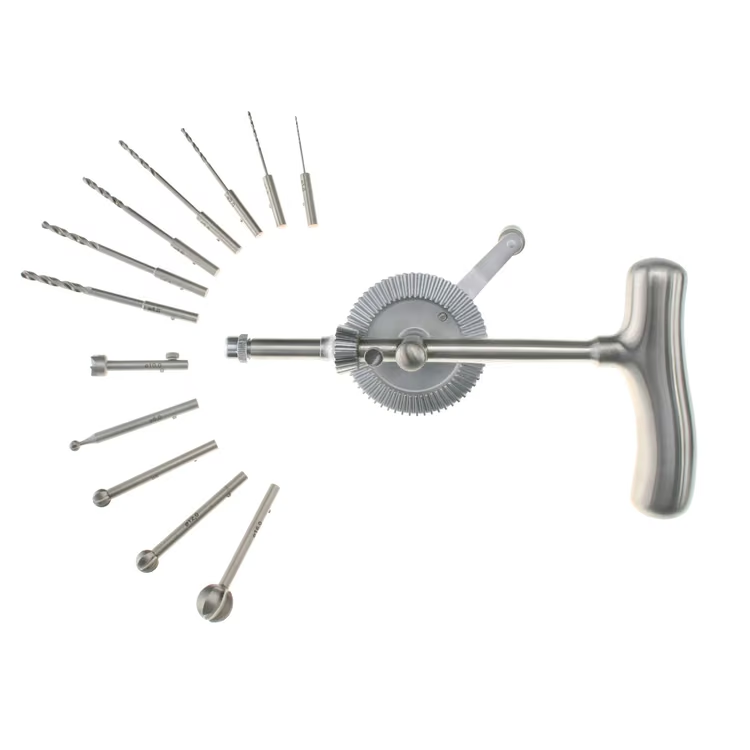
A manual bone hand drill is a hand-operated instrument used to produce rotational movement for drilling into bone. Depending on its design, it may feature a handle, rotating mechanism, and chuck or another system for securing a compatible drill bit.
Manual bone drills do not rely on an electric motor or battery-powered drive. Their operating mechanism and control characteristics differ from those of powered surgical drills.
Key Features
Hand-operated drilling mechanism
Chuck or bit-retention system, depending on the design
Compatibility with specified drill bits
Reusable construction in many surgical models
Availability in different sizes and configurations
Orthopedic Applications
Manual bone drills may be used in selected orthopedic applications where the instrument's design and operating characteristics are appropriate. Their suitability depends on the required drilling task and the manufacturer's stated intended use.
When selecting a manual drill, buyers should check the chuck capacity, compatible bit types, overall dimensions, material specifications, and reprocessing instructions.
2. Powered Surgical Bone Drill
A powered surgical bone drill uses a motorized drive system to rotate a compatible drill bit. Depending on the model, the power source may be electric, battery-operated, or another manufacturer-specified system.
Powered drills are widely used in orthopedic procedures requiring controlled rotary drilling. Some systems offer adjustable operating settings or specialized attachments designed for particular applications.
Key Features
Motorized rotary operation
Compatibility with designated surgical drill bits
Different handpiece and attachment configurations
Power and speed settings that vary by model
Reusable or single-use components, depending on the system
Orthopedic Applications
Powered bone drills are commonly used during fracture fixation and other orthopedic procedures that require holes for screws, pins, or other fixation components.
The selected drill must be compatible with the intended procedure and implant system. Operators must follow the manufacturer's instructions for operating settings, accessories, cleaning, and maintenance.
3. Orthopedic Drill Bits
Drill bits are the cutting components that create the hole in bone. They are available in different diameters, lengths, cutting geometries, and connection types.
Selecting the correct drill bit is essential because the required dimensions depend on the fixation system, screw specifications, bone characteristics, and surgical technique.
Common Drill-Bit Characteristics
Diameter: Determines the nominal width of the drilled hole.
Length: Influences the drilling depth and access requirements.
Cutting design: Varies according to the bit's intended application.
Connection type: Must match the compatible handpiece or drill chuck.
Material and construction: Depend on the manufacturer and intended use.
Orthopedic Applications
Orthopedic drill bits are used to prepare bone for fixation screws, pins, and other components. Different implant systems may require different drill-bit specifications.
A drill bit should not be selected based on diameter alone. The correct specification must be confirmed using the relevant implant documentation and manufacturer instructions.
4. Cannulated Bone Drills
Cannulated bone drills have a hollow central passage designed to accommodate a compatible guide wire or another specified component. This design allows drilling to be performed along a predetermined path when the relevant surgical technique calls for guided placement.
Cannulated systems are used in selected orthopedic procedures where maintaining alignment with a guide wire is important.
Key Features
Hollow central passage
Compatibility with specified guide wires
Different diameters and working lengths
Design variations for particular surgical systems
Requirements for matching accessories and procedural techniques
Orthopedic Applications
Cannulated drills may be used in selected fixation procedures involving guide wires and compatible implants. The drill, guide wire, and implant system must be appropriately matched.
Not every orthopedic drill is cannulated, and not every cannulated drill is compatible with every guide wire. Always verify the manufacturer's compatibility requirements.
5. Drill Guides and Drill Sleeves
Drill guides and sleeves are accessories used to support drill positioning during selected orthopedic procedures. They help establish the intended drilling direction and may protect surrounding structures or soft tissue when used as designed.
Key Features
Defined openings for compatible drill bits
Support for positioning and alignment
Different dimensions and configurations
Compatibility with specific instruments or implant systems
Reusable or single-use options, depending on the product
Orthopedic Applications
Drill guides and sleeves are commonly associated with procedures requiring a controlled drilling trajectory, including selected plate-and-screw fixation techniques.
Their dimensions and design must match the relevant drill bit, guide system, and surgical technique.
6. Kirschner Wires and Guide Wires
Kirschner wires, commonly called K-wires, are slender orthopedic wires used in selected procedures for temporary fixation, guidance, or stabilization. Guide wires are also used to establish a pathway for compatible cannulated instruments and implants.
These wires are not conventional drill bits. However, they are closely associated with orthopedic drilling systems because some techniques use a wire to guide subsequent instrumentation.
Key Features
Available in different diameters and lengths
Straight or other specified configurations
Compatibility with particular instruments and implants
Use in temporary fixation or guided placement, depending on the product
Orthopedic Applications
K-wires may be used in selected fracture fixation and other orthopedic procedures. Guide wires can assist with alignment when used as part of an approved surgical technique.
Wire selection depends on the intended application, the compatible instruments, and the relevant procedural requirements.
7. Drill Depth Gauges
A drill depth gauge is a measuring instrument used to determine the depth of a drilled hole or assess the required screw length according to the applicable technique.
Although a depth gauge does not perform the drilling itself, it is an important supporting instrument in many orthopedic fixation systems.
Key Features
Graduated measuring scale
Probe or measuring element, depending on the design
Different measurement ranges
Compatibility with specified implant systems or techniques
Orthopedic Applications
Depth gauges are used in selected fixation procedures to support appropriate screw-length selection. The measurement method depends on the instrument design and the manufacturer's instructions.
Correct measurement helps the surgical team select components according to the intended fixation requirements.
8. Bone Reamers
Bone reamers are cutting instruments designed to enlarge or prepare a bone canal or cavity for a particular orthopedic application. They are related to bone preparation but are not interchangeable with conventional drill bits.
Reamers may be manual or powered, depending on the design and intended use.
Key Features
Cutting surfaces designed for bone preparation
Different diameters and working lengths
Manual or powered configurations
Compatibility requirements for specified instruments or systems
Orthopedic Applications
Reamers are used in selected procedures involving canal preparation, including certain reconstructive and implant-related operations. Their use depends on the surgical plan and the relevant instrument system.
Because reaming differs from drilling, the appropriate tool must be selected according to the intended bone-preparation task.
Comparison of Common Bone Drilling Instruments
| Instrument | Primary Function | Typical Orthopedic Role |
|---|---|---|
| Manual bone hand drill | Hand-operated rotary drilling | Selected drilling applications |
| Powered surgical bone drill | Motorized rotary drilling | Bone-hole preparation for fixation and other procedures |
| Orthopedic drill bit | Cuts the bone opening | Creates holes to specified dimensions |
| Cannulated drill | Drilling over a compatible guide wire | Guided bone preparation |
| Drill guide or sleeve | Supports drill positioning | Helps establish the intended drilling direction |
| K-wire or guide wire | Guidance or temporary fixation | Provides a pathway or stabilization, depending on the technique |
| Drill depth gauge | Measures hole depth or supports screw-length selection | Assists fixation planning |
| Bone reamer | Enlarges or prepares a bone canal or cavity | Specialized bone preparation |
The instruments listed above have different functions. A drill bit performs the cutting, a drill provides rotational movement, and guides, wires, and gauges support positioning or measurement.
How to Choose the Right Bone Drilling Instruments
Selecting orthopedic drilling instruments requires attention to the procedure, implant specifications, and instrument compatibility.
1. Identify the Surgical Application
Determine whether the instrument is required for fracture fixation, pin placement, guided drilling, canal preparation, or another specific procedure.
2. Select the Appropriate Drill Type
Choose between a manual and powered drill according to the intended application, instrument specifications, and requirements of the surgical team.
3. Verify Drill-Bit Dimensions
Check the required diameter, length, cutting design, and connection type. Confirm the specifications against the relevant implant system.
4. Check Compatibility
Ensure that the drill, bit, guide sleeve, guide wire, and implant components are compatible. Similar-looking instruments may have different connection standards or intended uses.
5. Review Instrument Materials
Confirm the materials and construction stated by the manufacturer. Do not assume that all surgical drills and accessories use the same materials or have identical performance characteristics.
6. Consider Reprocessing Requirements
Verify whether each component is reusable or single-use. For reusable products, follow the manufacturer's validated cleaning, inspection, sterilization, and maintenance instructions.
7. Review Documentation
Check the manufacturer's product specifications and instructions for use. This is particularly important when purchasing instruments for a specific implant system or clinical application.
Cleaning, Sterilization and Maintenance
Reusable bone drilling instruments require appropriate cleaning, inspection, and sterilization according to the manufacturer's instructions.
Drill bits should be inspected for wear, damage, corrosion, or impaired cutting surfaces. Drill handpieces and manual mechanisms should be checked for proper operation, while compatible accessories should be inspected for damage and correct fit.
Powered systems may have specific requirements for battery handling, lubrication, cleaning, and sterilization. These requirements differ between manufacturers and models.
Do not assume that every drill, handpiece, battery, or accessory can be immersed or sterilized using the same method. Follow the product-specific instructions and remove damaged or malfunctioning components from service in accordance with facility procedures.
Frequently Asked Questions
1. What are the most common bone drilling instruments used in orthopedic surgery?
Common instruments and accessories include manual bone drills, powered surgical drills, orthopedic drill bits, cannulated drills, drill guides, guide wires, K-wires, and drill depth gauges. Bone reamers are also used for specialized bone-preparation tasks.
2. What is the difference between a manual bone drill and a powered surgical drill?
A manual bone drill is operated by hand, while a powered surgical drill uses a motorized drive system. Their appropriate applications depend on the instrument design, procedural requirements, and manufacturer's instructions.
3. What are orthopedic drill bits used for?
Orthopedic drill bits create openings in bone for compatible screws, pins, and other fixation components. Their dimensions and cutting design must match the intended application.
4. What is a cannulated bone drill?
A cannulated bone drill has a hollow central passage that accommodates a compatible guide wire or specified component. It is used in selected techniques that require guided drilling.
5. Are K-wires considered bone drill bits?
No. K-wires are slender orthopedic wires used for guidance, temporary fixation, or stabilization, depending on the application. They may be used alongside drilling instruments but serve a different function from conventional drill bits.
6. What is the purpose of a drill guide?
A drill guide helps position a compatible drill bit and supports the intended drilling trajectory. Its suitability depends on the guide design and the relevant surgical system.
7. Why is a drill depth gauge used in orthopedic surgery?
A drill depth gauge measures the depth of a prepared hole or supports screw-length selection according to the relevant technique. It is a measuring instrument rather than a drilling instrument.
8. What is the difference between a bone drill and a bone reamer?
A bone drill generally creates a hole, while a bone reamer is designed to enlarge or prepare a canal or cavity. They perform different functions and should be selected according to the intended procedure.
9. How do I choose the correct orthopedic drill bit?
Confirm the required diameter, length, cutting geometry, connection type, and compatibility with the implant system. Follow the manufacturer's specifications rather than selecting a bit based only on its appearance.
10. How should orthopedic bone drilling instruments be maintained?
Follow the manufacturer's instructions for cleaning, inspection, sterilization, and maintenance. Inspect cutting surfaces, connections, and moving parts for wear or damage before use.
Conclusion
Bone drilling instruments play an important role in orthopedic procedures involving fracture fixation, bone preparation, and implant placement. Manual and powered drills provide rotational movement, while drill bits perform the cutting and accessories such as guides, wires, and depth gauges support positioning and measurement.
Bone reamers provide a related but distinct function by preparing or enlarging bone canals and cavities. Understanding these differences helps healthcare professionals and surgical instrument buyers compare products more accurately.
When sourcing bone drilling instruments, verify the intended application, dimensions, compatibility, materials, and manufacturer-approved reprocessing requirements. Choosing instruments according to their actual specifications supports appropriate equipment selection for the intended orthopedic procedure.