

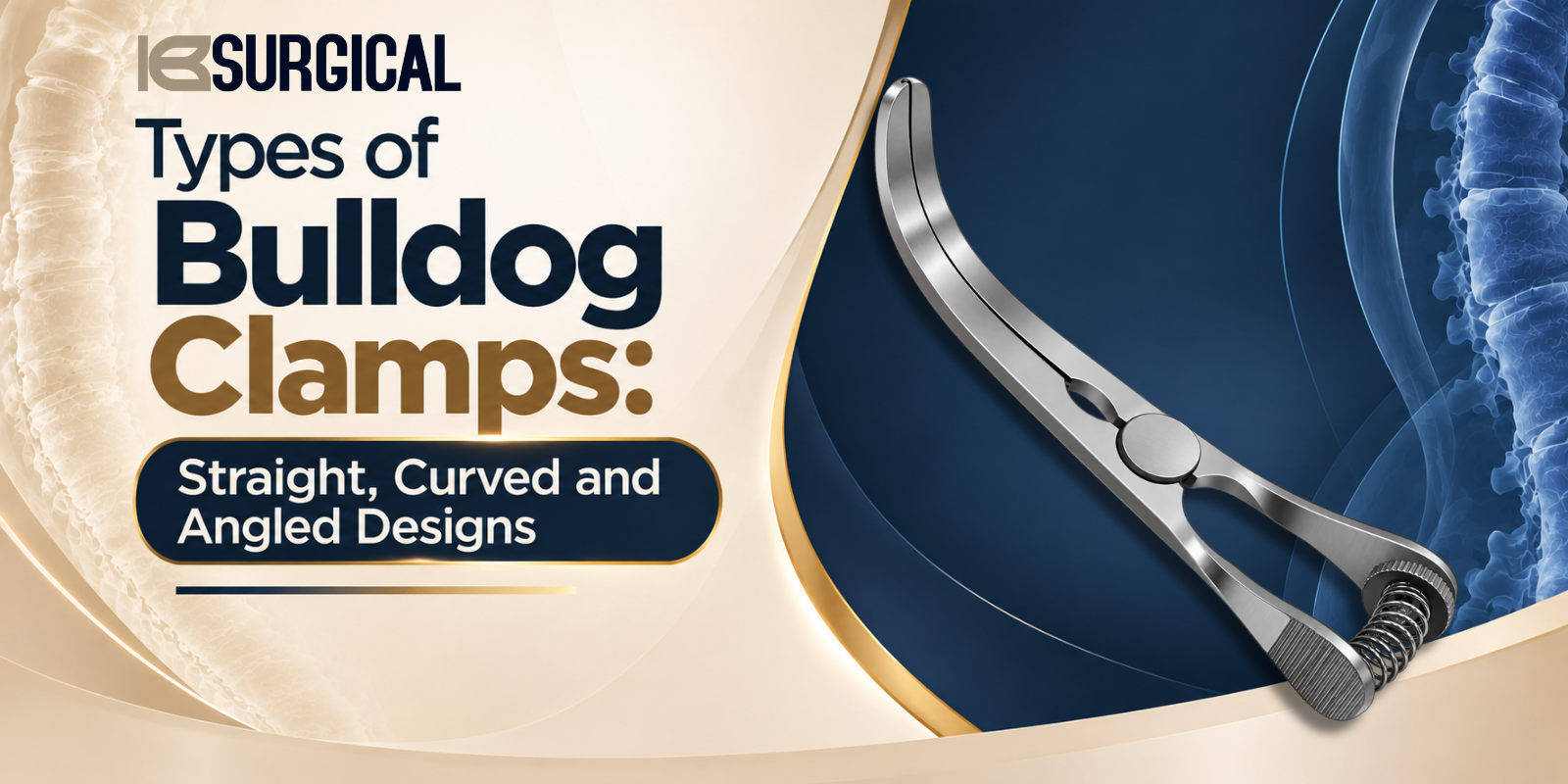
Bulldog clamps are specialized surgical instruments designed for temporary occlusion of blood vessels during selected surgical procedures. Their compact construction and spring-operated mechanism allow them to apply controlled pressure across a vessel, helping surgeons manage blood flow within the operative field.
These instruments are available in different configurations, including straight, curved, and angled designs. Each configuration offers a different jaw orientation and access profile, making the choice of instrument dependent on the surgical approach, anatomical location, vessel characteristics, and manufacturer's specifications.
Understanding the types of bulldog clamps can help surgeons, operating room teams, procurement professionals, and surgical instrument distributors compare available designs and select instruments suited to their intended applications.
What Is a Bulldog Clamp?
A bulldog clamp is a small, spring-loaded vascular instrument used to temporarily compress a blood vessel. Unlike larger vascular clamps, bulldog clamps generally have a compact profile and are designed for applications where a smaller instrument may be appropriate.
Most conventional bulldog clamps feature two opposing jaws connected to a spring mechanism. The spring provides the closing force, while the jaw surfaces are designed to contact the vessel. Depending on the model, the jaws may be straight, curved, or angled relative to the instrument's body.
Bulldog clamps are used in selected vascular and cardiovascular procedures and may be available in specialized versions for delicate surgical applications. Their suitability depends on the specific instrument design, intended use, vessel characteristics, and the manufacturer's instructions.
Main Types of Bulldog Clamps
The three commonly discussed configurations are straight, curved, and angled bulldog clamps. Although these names describe the general jaw orientation, exact designs and available specifications vary among manufacturers.
1. Straight Bulldog Clamps
Straight bulldog clamps feature jaws that follow a relatively straight alignment. This configuration provides a direct approach when the vessel can be accessed without requiring a pronounced change in jaw direction.
Key Features
Straight jaw alignment
Compact construction in many models
Spring-operated closing mechanism
Availability in different jaw lengths and clamping forces
Jaw surfaces that may be smooth, serrated, or otherwise patterned, depending on the model
Applications
Straight bulldog clamps may be considered for temporary vessel occlusion when a direct approach is suitable. The actual application depends on the procedure and the instrument's intended use.
Their relatively straightforward jaw geometry can also make product specifications easier to compare across similar models.
When to Consider a Straight Design
A straight model may be appropriate when the target vessel is accessible and the jaw orientation aligns with the intended clamping position. The surgeon must consider the available working space, surrounding anatomy, vessel diameter, and required clamping characteristics.
2. Curved Bulldog Clamps
Curved bulldog clamps feature jaws with a curved profile. The degree and direction of curvature vary by design, so not every curved model provides the same access or working orientation.
Key Features
Curved jaw profile
Different curvature patterns and jaw lengths
Spring-operated closing action in conventional designs
Compact options for selected vascular applications
Variations in jaw surface and clamping force
Applications
Curved bulldog clamps may be useful when the target vessel's position or the surgical approach makes a curved jaw profile more suitable than a straight configuration.
The curvature can influence how the jaws approach the vessel and how the instrument fits within the operative field. However, curvature alone does not determine whether a clamp is suitable for a particular vessel or procedure.
When to Consider a Curved Design
A curved design may be worth evaluating when a straight jaw orientation does not align well with the target vessel or surrounding anatomy. The specific curvature, jaw length, and working dimensions should be reviewed before selection.
3. Angled Bulldog Clamps
Angled bulldog clamps have jaws or a working end positioned at an angle relative to the instrument's body. Depending on the model, the angle may provide a different approach to the target vessel without requiring the entire instrument to follow the same direction.
Angled designs should not automatically be treated as identical to curved models. A curved jaw follows a curved profile, while an angled design generally changes direction at a defined orientation. Some instruments may combine features of both designs.
Key Features
Angled jaw or working-end orientation
Different angles and jaw configurations, depending on the model
Spring-operated mechanism in conventional designs
Options intended for different access requirements
Variations in overall length, jaw dimensions, and clamping force
Applications
Angled bulldog clamps may be considered for vascular applications in which the approach angle is an important factor. Their suitability depends on the target anatomy, the required access direction, and the specific instrument design.
When to Consider an Angled Design
An angled configuration may be useful when the instrument needs to approach the vessel from a particular direction or when the body of a straight instrument would interfere with the available working space.
The appropriate angle must be selected according to the surgical plan and the manufacturer's product specifications.
Straight vs Curved vs Angled Bulldog Clamps
The main difference between these configurations is the orientation of the jaws and how that geometry relates to the intended working position.
| Feature | Straight Bulldog Clamp | Curved Bulldog Clamp | Angled Bulldog Clamp |
|---|---|---|---|
| Jaw geometry | Relatively straight | Curved jaw profile | Jaw or working end set at an angle |
| Approach | Direct alignment | Follows a curved profile | Provides an angled approach |
| Access considerations | Suitable when straight alignment is practical | May suit a curved approach to the vessel | May suit a specific approach direction |
| Design variations | Jaw length, width, surface and force | Curvature, jaw dimensions and force | Angle, jaw dimensions and force |
| Selection priority | Alignment with the target vessel | Curvature and available space | Approach angle and surrounding anatomy |
Important: No design is universally better than another. The correct choice depends on the target vessel, the intended procedure, the clamp's closing force, the jaw surface, and the manufacturer's stated indications.
How Bulldog Clamps Work
Conventional bulldog clamps use a spring mechanism to bring the jaws together. The jaws apply pressure to the vessel when the clamp is positioned and engaged according to its design.
Several characteristics affect the instrument's performance:
Spring Force
The spring mechanism determines the force applied as the jaws close. Excessive or inappropriate pressure can damage delicate vascular tissue, so the instrument must be suitable for the intended vessel and application.
Jaw Surface
Jaw surfaces may be smooth, serrated, or designed with a specific contact pattern. The appropriate surface depends on the instrument's intended use and the manufacturer's design specifications.
Jaw Length and Width
Jaw dimensions affect the contact area and the range of vessels for which the model may be intended. A clamp should not be selected based on its overall length alone.
Instrument Orientation
Straight, curved, and angled configurations change how the jaws approach the target. The selected design should provide appropriate access without compromising the required positioning.
Pediatric Bulldog Clamps
Pediatric bulldog clamps are specialized options intended for selected applications involving smaller anatomical structures. However, the term "pediatric" alone does not establish that a particular clamp is appropriate for every pediatric vessel.
When comparing pediatric models, review:
Jaw length and width
Straight, curved, or angled configuration
Spring force and clamping characteristics
Jaw surface and contact profile
Overall instrument dimensions
Manufacturer-stated intended use and vessel suitability
Selection must be based on the requirements of the procedure and the clinical team's judgment. A smaller instrument is not automatically suitable for a smaller vessel; its design and clamping characteristics must also be appropriate.
How to Choose the Right Bulldog Clamp
Selecting a bulldog clamp involves more than choosing a jaw shape. The complete instrument specification should be reviewed before purchasing or using a particular model.
1. Identify the Intended Application
Confirm the procedure and the type of vessel for which the instrument is designed. Not all bulldog clamps are suitable for every vascular application.
2. Select the Jaw Configuration
Determine whether a straight, curved, or angled design best matches the required approach and available surgical space.
3. Review the Clamping Force
Check the manufacturer's information on spring force and intended vessel suitability. The instrument should provide appropriate occlusion without applying unsuitable pressure.
4. Check Jaw Dimensions
Review jaw length, width, and contact surface. These specifications help establish whether the instrument is appropriate for the intended application.
5. Consider the Available Working Space
Assess the access direction, surrounding anatomy, and space available for positioning the instrument. The jaw configuration should support the intended approach.
6. Verify Material and Reprocessing Requirements
Confirm the instrument's material, reusable or single-use status, and manufacturer-approved cleaning and sterilization instructions.
7. Review Product Documentation
Check the manufacturer’s product reference, intended-use information, and applicable instructions for use. This is particularly important when comparing instruments marketed for delicate or pediatric applications.
Cleaning, Sterilization and Maintenance of Bulldog Clamps
Reusable bulldog clamps require appropriate cleaning, inspection, and sterilization in accordance with the manufacturer's instructions.
The spring mechanism, jaws, joints, and contact surfaces should be inspected for damage, corrosion, deformation, or impaired operation. The closing mechanism should function as specified, and the jaw surfaces should remain in suitable condition.
Follow the manufacturer's validated reprocessing instructions rather than assuming that all bulldog clamps can be processed in the same way. Any instrument that does not operate correctly or shows damage should be assessed according to facility procedures and the manufacturer's guidance before further use.
Proper handling, inspection, and maintenance help preserve instrument performance and support consistent instrument processing.
Frequently Asked Questions
1. What are the main types of bulldog clamps?
The commonly discussed configurations include straight, curved, and angled bulldog clamps. They differ primarily in jaw orientation and approach geometry.
2. What is a straight bulldog clamp used for?
A straight bulldog clamp may be used for temporary vascular occlusion when a direct jaw alignment is suitable for the intended procedure. Its use depends on the model and the manufacturer's specifications.
3. What is the difference between a curved and an angled bulldog clamp?
A curved bulldog clamp has jaws that follow a curved profile. An angled bulldog clamp has a working end or jaw orientation set at an angle relative to the instrument's body. Some designs may combine both characteristics.
4. Are bulldog clamps used in vascular surgery?
Yes. Bulldog clamps are commonly associated with temporary vascular occlusion in selected vascular and cardiovascular procedures. The appropriate model depends on the procedure and intended use.
5. What should I consider when selecting a pediatric bulldog clamp?
Review jaw dimensions, clamping force, jaw surface, instrument orientation, and the manufacturer's stated intended use. The term "pediatric" alone is not enough to establish suitability for a particular vessel.
6. Do all bulldog clamps have the same clamping force?
No. Clamping force can vary by model and design. Consult the manufacturer's specifications to determine whether a particular instrument is appropriate for the intended application.
7. Are bulldog clamps reusable?
Some bulldog clamps are reusable, while availability and processing requirements vary by product. Confirm the instrument's status and follow its manufacturer-approved instructions for cleaning and sterilization.
8. How should bulldog clamps be maintained?
Follow the manufacturer's cleaning, inspection, and sterilization instructions. Regularly inspect the spring mechanism, jaws, and contact surfaces for damage or impaired function.
9. Are straight bulldog clamps better than curved or angled models?
No configuration is universally better. The appropriate choice depends on the surgical approach, target vessel, working space, jaw dimensions, and instrument specifications.
10. Can the same bulldog clamp be used for every vessel?
No. Instrument suitability depends on the vessel characteristics, required occlusion, clamping force, and manufacturer's intended-use information. The clinical team must determine the appropriate instrument for the procedure.
Conclusion
Straight, curved, and angled bulldog clamps offer different jaw orientations for selected vascular applications. Straight models provide a relatively direct alignment, curved models follow a curved jaw profile, and angled models offer a different working-end orientation.
The best choice depends on the intended procedure, target vessel, available surgical space, jaw dimensions, clamping force, and manufacturer's specifications. For surgical instrument buyers and healthcare professionals, comparing these features provides a more reliable basis for selection than relying on the product name alone.
When sourcing bulldog clamps, verify the manufacturer's documentation, intended use, material specifications, and reprocessing requirements to ensure that the selected instrument meets the needs of the intended application.