

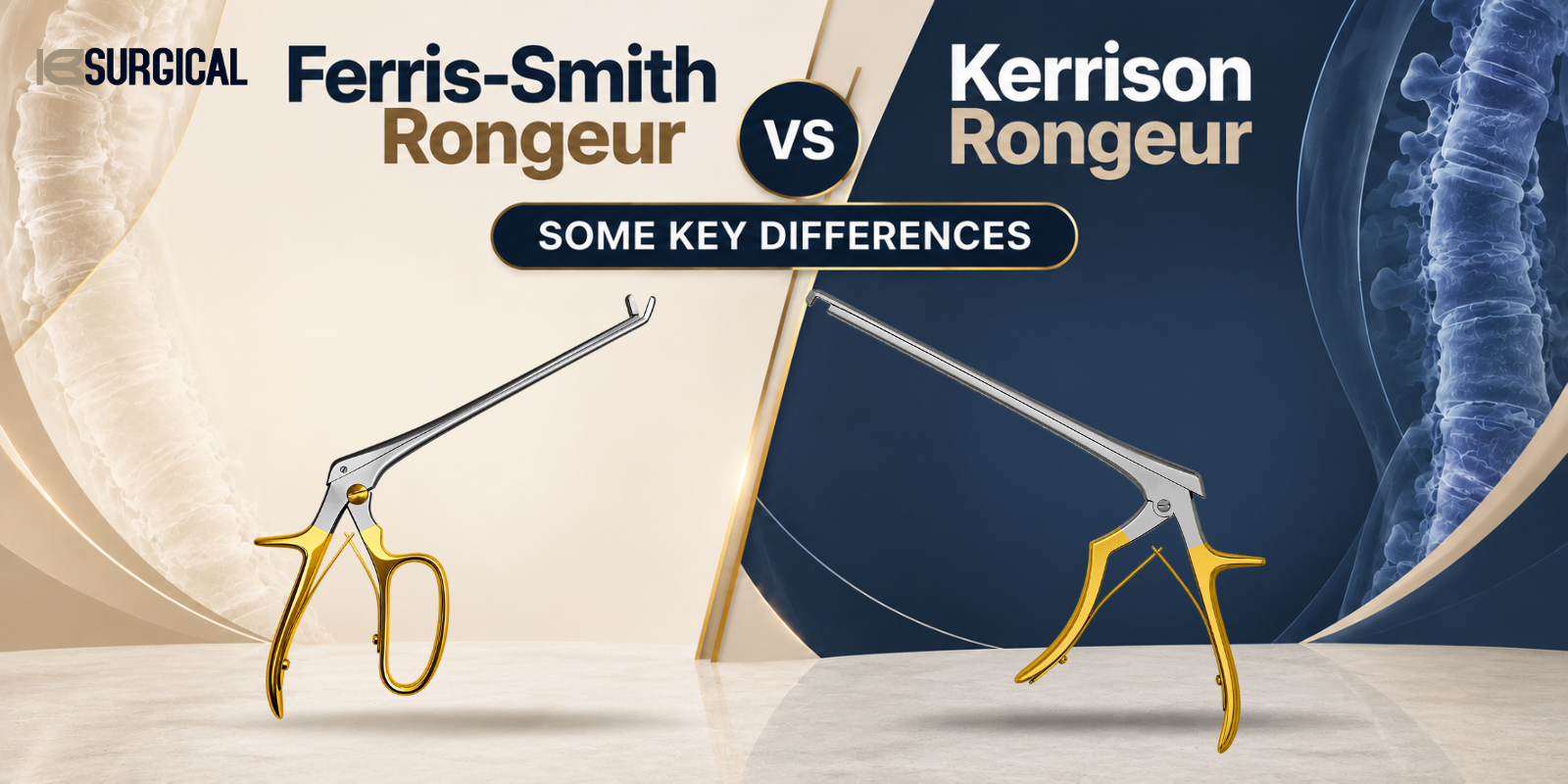
Ferris-Smith rongeurs and Kerrison rongeurs are specialized surgical instruments used for controlled removal of small amounts of bone and other tissue, depending on the instrument design and intended application. They are commonly associated with spinal surgery, laminectomy procedures, and other operations requiring access to confined anatomical areas.
Although these instrument names are sometimes used interchangeably in product catalogs, they do not always describe two completely separate instrument categories. The term Ferris-Smith-Kerrison Rongeur is also used for instruments combining these naming conventions. Differences between individual models may include handle design, jaw geometry, cutting angle, footplate profile, bite width, and working length.
Understanding these features helps healthcare procurement teams, surgical instrument distributors, and medical professionals compare available models and identify the specifications required for a particular application.
What Is a Ferris-Smith Rongeur?
A Ferris-Smith rongeur is a surgical cutting instrument available in different configurations for controlled removal of small portions of bone. Ferris-Smith patterns are commonly listed in orthopedic and neurosurgical instrument catalogs, including models with straight, upward-angled, or downward-angled cutting ends.
Depending on the model, the instrument may have a long shaft, a hinged handle mechanism, and cutting jaws designed to reach a particular working area. These features can help provide access and control when working in restricted surgical spaces.
Key Features of Ferris-Smith Rongeurs
Long working shaft: Available in different lengths to accommodate instrument access requirements.
Multiple jaw configurations: Models may have straight or angled cutting ends.
Different bite sizes: Common catalog options include 2 mm, 3 mm, 4 mm, 5 mm, and 6 mm, depending on the model.
Controlled cutting mechanism: Designed to remove tissue in small bites rather than large sections.
Specialized surgical applications: Frequently listed for orthopedic, spinal, and neurosurgical procedures.
Ferris-Smith instruments are available in several configurations, so the exact specifications should always be checked against the manufacturer's product listing.
What Is a Kerrison Rongeur?
A Kerrison rongeur, often called a Kerrison punch, is a surgical instrument designed for controlled cutting and removal of small portions of bone or other tissue specified for the instrument. It is widely associated with spinal decompression and laminectomy procedures.
A common Kerrison design includes a handle mechanism, a long shaft, a movable cutting jaw, and a footplate that supports the cutting action. The footplate profile and jaw angle vary between models, allowing surgeons to select an instrument configuration suited to the required access and working space.
Key Features of Kerrison Rongeurs
Footplate design: Many models use a thin footplate that can be positioned beneath the tissue being removed.
Angled cutting jaws: Common configurations include upward- and downward-cutting designs.
Multiple bite widths: Sizes may range from approximately 1 mm to 6 mm, depending on the product range.
Different shaft lengths: Shorter and longer versions are available for different access requirements.
Handle variations: Standard, ring-handle, and other ergonomic designs may be offered.
Reusable and specialized versions: Availability depends on the manufacturer and product specification.
Kerrison rongeurs are widely associated with spinal surgery, but the correct instrument must be selected according to its intended use, design, and applicable instructions for use.
Ferris-Smith Rongeur vs Kerrison Rongeur: Key Differences
The most important point is that these names may overlap in commercial catalogs. A Ferris-Smith-Kerrison model may share features with a conventional Kerrison rongeur, so the instrument's actual specifications are more useful than the name alone.
| Feature | Ferris-Smith Rongeur | Kerrison Rongeur |
|---|---|---|
| Naming | A named rongeur pattern used in surgical catalogs | A widely recognized rongeur and punch designation |
| Typical design options | Straight, upward-angled, and downward-angled configurations, depending on the model | Straight or angled cutting configurations, depending on the model |
| Footplate | Varies by pattern and manufacturer | Thin-footplate and other designs are available |
| Bite sizes | Common options include several millimeter widths | Common options include several millimeter widths |
| Shaft length | Available in different lengths | Available in different lengths |
| Handle design | Depends on the specific model | Standard, ring-style, and other handle configurations may be available |
| Surgical applications | Orthopedic and neurosurgical applications, depending on the model | Commonly associated with spinal and neurosurgical procedures |
| Selection criteria | Jaw shape, cutting direction, dimensions, and intended application | Footplate, jaw angle, bite width, shaft length, and intended application |
Important: These are general catalog distinctions, not universal rules. Some manufacturers explicitly list Ferris-Smith-Kerrison rongeurs as a combined pattern. Always compare the actual instrument design and product specifications before treating two models as different instruments.
Differences in Jaw Design and Cutting Angle
Jaw geometry is one of the most important factors when comparing rongeurs. The cutting end determines the instrument's working orientation and can influence access to the intended area.
Straight Cutting Configuration
Straight models have a cutting end aligned with the instrument's shaft. This configuration may be appropriate when the working area allows a relatively direct approach.
Upward-Cutting Configuration
Up-biting or upward-cutting models have jaws angled upward relative to the shaft. Depending on the anatomy and surgical approach, this geometry may help the operator access a particular surface or working direction.
Downward-Cutting Configuration
Down-biting or downward-cutting models orient the cutting jaws in the opposite direction. The appropriate choice depends on the required approach and the model's intended application.
Footplate Profile
The footplate is another important design feature, particularly for Kerrison-style punches. A thin footplate may help the instrument reach beneath tissue in a confined space. However, the required profile and dimensions should be determined from the intended procedure and the manufacturer's specifications.
Understanding Bite Sizes and Working Lengths
Bite width describes the width of the cutting opening or jaw, as specified by the manufacturer. It is an important consideration when comparing surgical rongeurs.
Commonly available sizes include 1 mm, 2 mm, 3 mm, 4 mm, 5 mm, and 6 mm, although availability varies by instrument pattern and manufacturer.
Working length also matters. A shorter instrument may suit a different access requirement than a longer-shaft model. Buyers should distinguish overall instrument length from working length because these measurements are not necessarily identical.
When comparing products, review the following specifications:
Jaw or bite width in millimeters
Jaw opening and cutting geometry
Up-biting, down-biting, or straight configuration
Footplate thickness and profile, where applicable
Overall length and working length
Handle style and operating mechanism
Manufacturer's stated material and reprocessing instructions
These details provide a more reliable basis for comparing instruments than product names alone.
Surgical Applications of Ferris-Smith and Kerrison Rongeurs
Ferris-Smith and Kerrison-style instruments are listed for several surgical applications, depending on the model and its intended use.
Spinal Surgery
Kerrison rongeurs are commonly associated with procedures requiring controlled bone removal around spinal structures. The instrument's shaft length, bite width, and jaw angle are important considerations when evaluating models for spinal surgery.
Laminectomy Procedures
Laminectomy instruments are used in operations involving removal of portions of the vertebral lamina. Kerrison punches are among the instruments commonly found in laminectomy instrument sets. The specific instrument configuration depends on the surgical plan and the manufacturer's intended-use information.
Neurosurgery
Selected rongeurs are designed for procedures requiring precise access and controlled removal of small amounts of tissue. Instrument dimensions and cutting geometry must match the intended surgical application.
Orthopedic Surgery
Some Ferris-Smith and related rongeur patterns are also included in orthopedic instrument catalogs. Their suitability depends on the particular model, the tissue involved, and its stated intended use.
Not every Ferris-Smith or Kerrison rongeur is suitable for every procedure. Selection should follow the surgeon's requirements and the manufacturer's instructions.
How to Choose the Right Rongeur
When selecting a Ferris-Smith or Kerrison rongeur, consider the complete product specification rather than relying solely on the instrument name.
1. Identify the intended application. Confirm the procedure and the type of tissue for which the instrument is designed.
2. Check the jaw configuration. Determine whether a straight, upward-cutting, or downward-cutting model is required.
3. Compare bite width. Review the manufacturer's stated jaw dimensions and available sizes.
4. Confirm the shaft length. Check both overall length and working length where provided.
5. Review footplate design. For Kerrison-style models, confirm the footplate profile and dimensions.
6. Evaluate handle ergonomics. Compare the available handle styles and operating mechanisms.
7. Verify material and reprocessing requirements. Confirm the instrument's material, reusable or single-use status, and manufacturer-approved cleaning, sterilization, and maintenance instructions.
8. Check compatibility and documentation. Verify any required compatibility with the instrument set and ensure the product documentation matches its intended use.
Cleaning, Sterilization, and Maintenance
Reusable surgical rongeurs require appropriate cleaning, inspection, and sterilization according to the manufacturer's instructions. The cutting jaws, hinge, shaft, and handle mechanism should be inspected for visible damage, corrosion, stiffness, or impaired function.
Follow the manufacturer's validated reprocessing procedure rather than assuming that all instruments use the same cleaning or sterilization method. Instruments that are damaged, difficult to operate, or unable to achieve the specified cutting action should be assessed and removed from service when required by the applicable instructions and facility procedures.
Proper maintenance helps preserve instrument function and supports consistent instrument processing.
Frequently Asked Questions
1. What is the main difference between a Ferris-Smith rongeur and a Kerrison rongeur?
The main distinction is often the product pattern or catalog designation rather than a universal difference in function. Ferris-Smith-Kerrison is also used as a combined name. Compare the jaw design, footplate, cutting angle, bite width, length, and intended application of the individual models.
2. Is a Ferris-Smith-Kerrison rongeur the same as a Kerrison punch?
Not necessarily in every catalog. The terms may overlap, but models can differ in design and dimensions. Check the manufacturer's product reference and specifications to establish whether two instruments are equivalent.
3. What bite sizes are available for Kerrison rongeurs?
Depending on the product range, common options include 1 mm, 2 mm, 3 mm, 4 mm, 5 mm, and 6 mm. Confirm the available sizes with the manufacturer.
4. What is the purpose of the footplate on a Kerrison rongeur?
The footplate supports the cutting mechanism and, in many designs, can be positioned beneath the tissue being removed. Its shape and thickness vary between models.
5. What do up-biting and down-biting mean?
These terms describe the orientation of the cutting jaws relative to the shaft. The appropriate configuration depends on the required working direction and the intended surgical application.
6. Are Ferris-Smith and Kerrison rongeurs used in laminectomy procedures?
Kerrison punches are commonly associated with laminectomy and spinal decompression instrument sets. The suitability of a particular Ferris-Smith or Ferris-Smith-Kerrison model depends on its intended use and specifications.
7. How do I choose the correct shaft length?
Compare the manufacturer's overall and working-length measurements with the required surgical access and the instrument specification requested by the clinical team.
8. How should reusable Kerrison rongeurs be maintained?
Follow the manufacturer's cleaning, inspection, lubrication where applicable, and sterilization instructions. Inspect the jaws and moving mechanism for damage or impaired function before use.
Conclusion
Ferris-Smith rongeurs and Kerrison rongeurs are closely related instrument names within the broader category of surgical cutting instruments. Although catalogs may present them as separate patterns, the terminology can overlap, especially for Ferris-Smith-Kerrison models.
For an accurate comparison, focus on the instrument's cutting angle, jaw dimensions, footplate design, working length, handle configuration, and intended application. These specifications help procurement teams and surgical instrument professionals identify the appropriate model while avoiding assumptions based solely on the product name.
When purchasing surgical rongeurs, consult the manufacturer's current catalog and instructions for use to confirm the exact specifications and suitability of each instrument.